← Home

The Enactor

A theatre for AI.

A guide, a guest, and something they can look at together. XI built the Enactor to direct what appears, who speaks, and how the scene responds when you ask a question.

Film transcript

Up until now, AI conversations were a lot of text and reading. Who has the time and what fun is that? Face-to-face conversations are typically more efficient and far more interesting. Watch this. Any questions on the menu? What wine would you recommend to go with lobster? Our lobster is beautifully complemented by the 2018 Joseph Colin Chassagne-Montrachet. Its elegant freshness, delicate notes of orchard fruit and peach, and beautifully balanced richness will pair wonderfully with the sweetness of the lobster.

May I bring you a glass to accompany your entree? That sounds amazing. Perfect. I will bring you both a glass. Now, guess who has been perfecting little dramatic enactments like this for over 2,000 years? That's right. The theater. So we built one to bring AI to life. Here's how we do it. We start by putting a face on it, ears to hear, eyes to see, and a mouth to talk.

That's table stakes. Lots of folks can do that. What sets this apart is that we then put that talking head right up here on stage where I stand. Let me show you how it works. Now every show needs a cast. There's a narrator, the voice, the face of the show who deeply knows the story. That's me. And then there's you. You're not in the audience tonight. You're up here on our stage with me.

Talk to me. Interrupt me. Pick things up. So every theater names its stage the same way. Left, center, right, upstage, downstage. Our stage is your screen and nothing on it stands still. Right now I have the whole stage. In a theater, a prop is anything we bring on to help tell the story and a cue is the moment it comes on. Now notice how our props, an image, a chart, a menu, land on the very sentence that speaks of them.

You hear it, you see it all at once. So would you like to learn a bit more about your wine selection? Where's it from? While he's learning about his wine, let me show you the magic backstage. The scenes change, the right props arrive on cue, and my voice, the chat, and the controls all move as one. That is our director, the AI. It decides what I say and what I show.

But every cue goes past our stage manager first, who checks it against the script. The director proposes. The stage manager disposes. Let's listen in. And why does it go so well with lobster? Lobster is sweet, and the butter is rich. This wine has the weight to meet them, and the freshness to keep every bite clean. Shall I add a bottle to your order? Yes, please.

Lovely. I'll have it served cool, not cold. Ladies and gentlemen, introducing the star of our show, the Enactor. Special thanks to XI for making enactments like this possible. And now, a toast to the Enactor, the future of human-computer interaction across all your devices, including mobile, tablets, and laptops. This is how we bring AI to life. This is how, together, we extend intelligence.

Every question changes the scene.

At the wine table, the guest decides where the conversation goes. Here’s what Dana brings on screen for four different questions.

Dana beside the Joseph Colin bottle and its recommendation.

“What wine would you recommend with lobster?”

Dana recommends a Chassagne-Montrachet. The guest sees the bottle as she names it.

A map of Chassagne-Montrachet and Saint-Aubin beside the wine label.

“Where’s it from?”

A Burgundy map and the bottle label show where the grapes grow and where Joseph has his cellar.

Chardonnay grapes beside tasting notes for orchard fruit, peach, and pastry.

“What does it taste like?”

Chardonnay grapes and tasting notes appear as Dana describes orchard fruit, peach, and a hint of pastry.

The lobster pairing beside the guest’s bottle order.

“Why does it go so well with lobster?”

Dana explains how the wine’s freshness balances the butter. When the guest says yes to a bottle, it appears on the order.

The secret is the cue.

Take a closer look at “Where’s it from?” Within that one answer, each sentence cues a change on the map or beside it.

Chassagne-Montrachet is marked with a gold dot on the Burgundy map.
“The grapes grow here, in the village of Chassagne-Montrachet.”
The Joseph Colin wine label appears beside the same map.
“Now, look at the label.”
Saint-Aubin is marked where Joseph has his cellar, about two kilometres from the village where the grapes grow.
“That’s the next village over, where Joseph has his cellar.”

How the AI theatre works.

Dana is the guide. The map and label are props she can bring on stage. The guest has a part, too: a question, a tap, or an interruption can change what happens next.

Wine Advisor workspace with Dana at left, the Burgundy map and label in the middle, and guest controls along the bottom.
  1. Guide · Dana
  2. Props · map and label
  3. Guest · conversation controls

Who calls the cue?

The script sets the rules. The Director proposes what to show next. The Stage Manager checks that the item belongs to this Enactment and that the cue still fits the conversation.

When the guest asks where the wine comes from, the map appears as Dana names the village.

The guest can change what’s on stage.

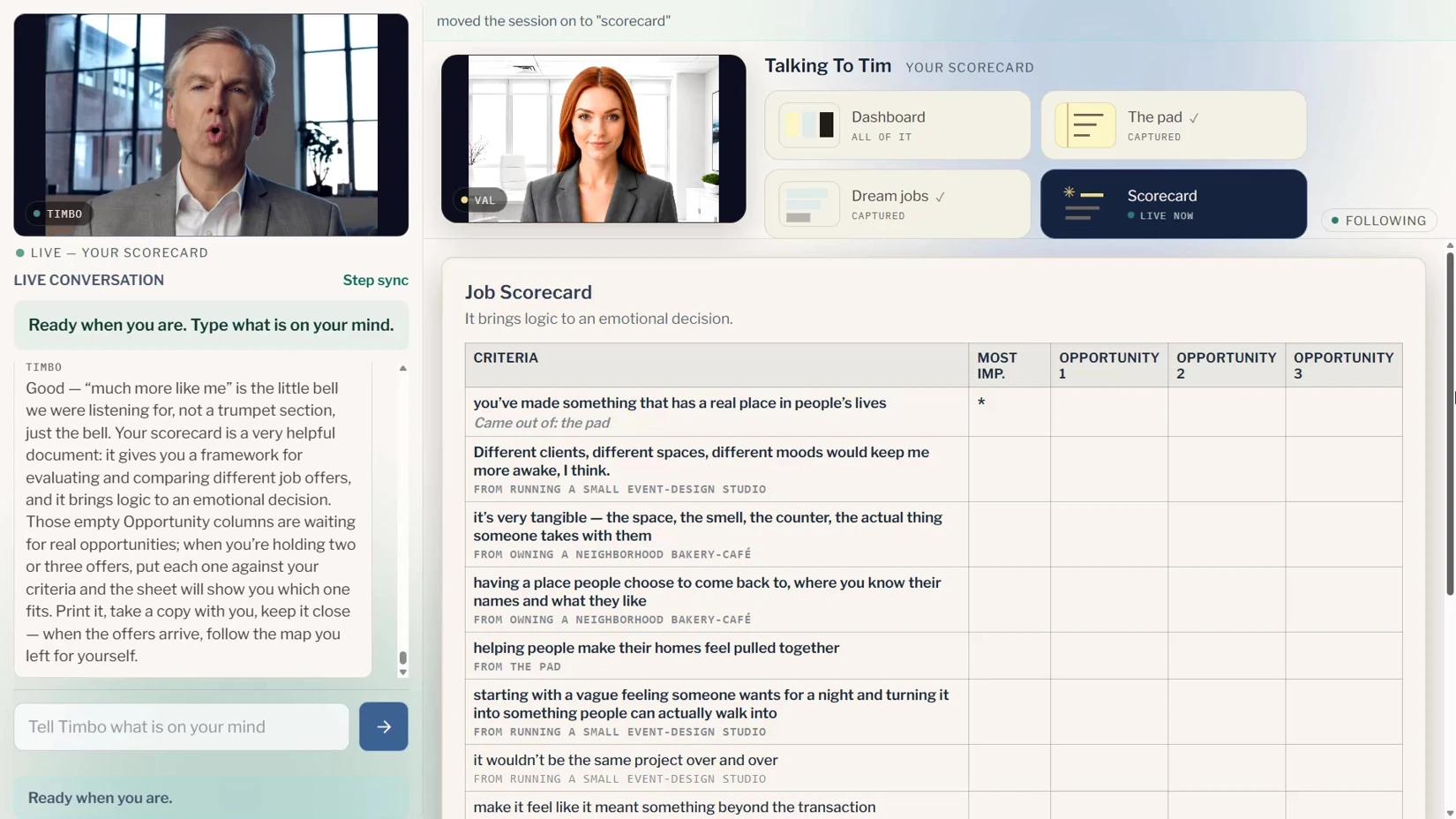
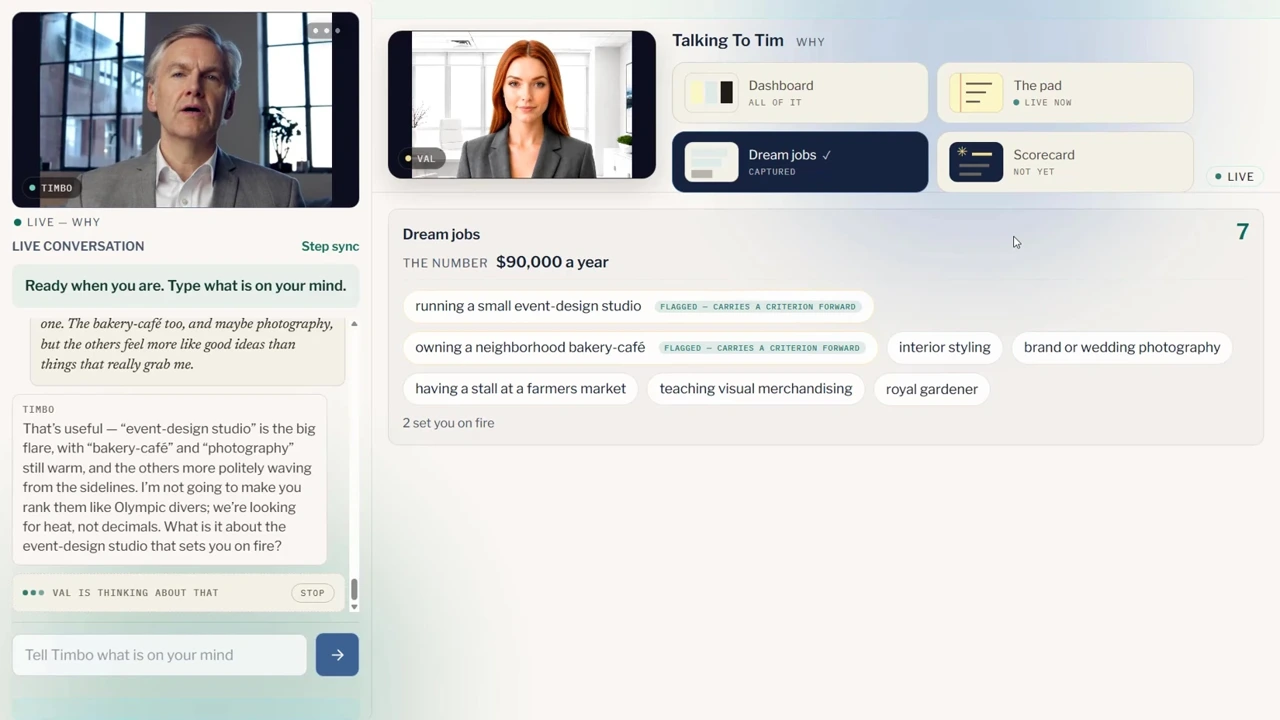
In Talking to Tim, the client and coach work on the same career decision. Their conversation takes shape in three places the client can see and edit.
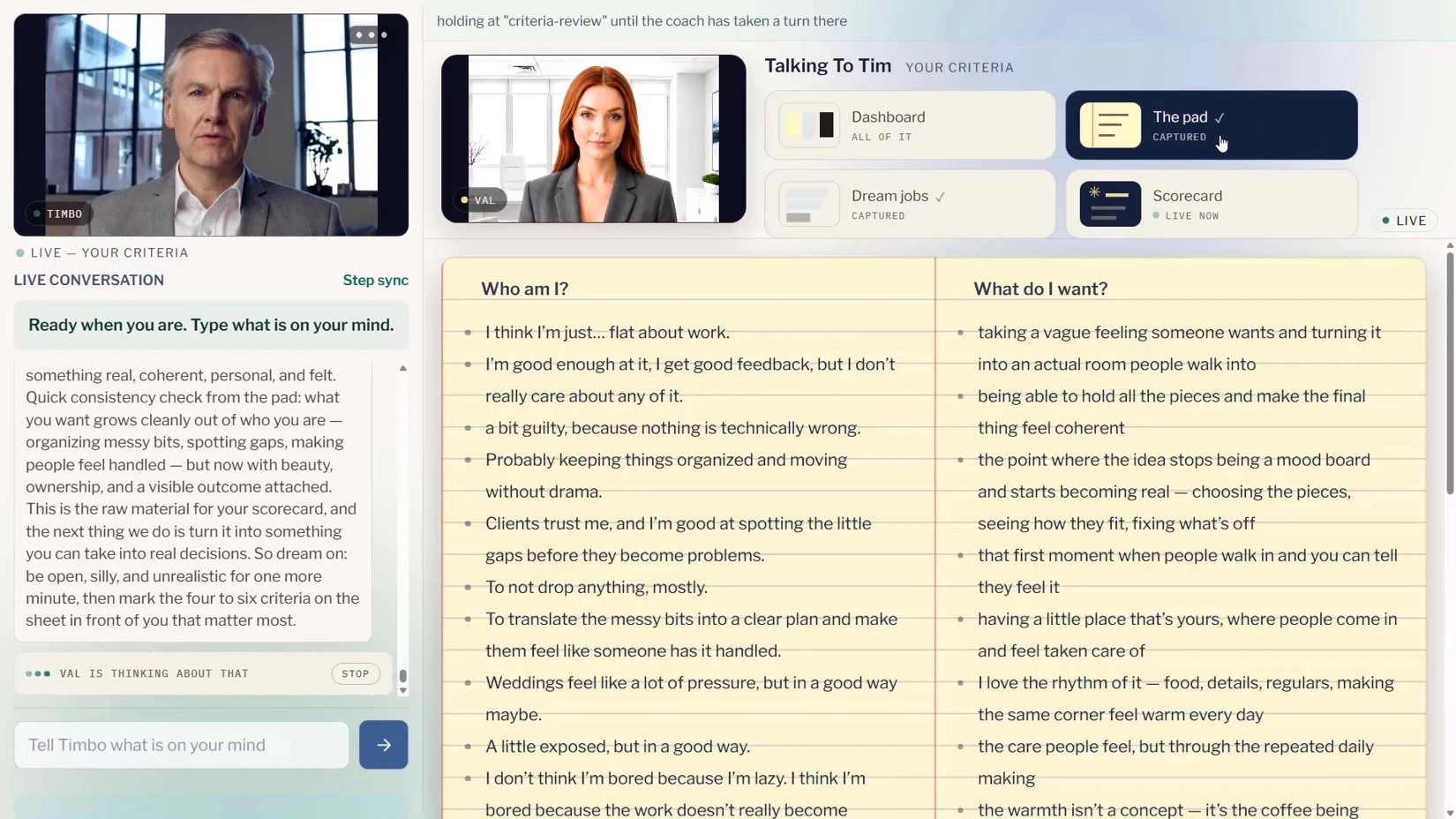
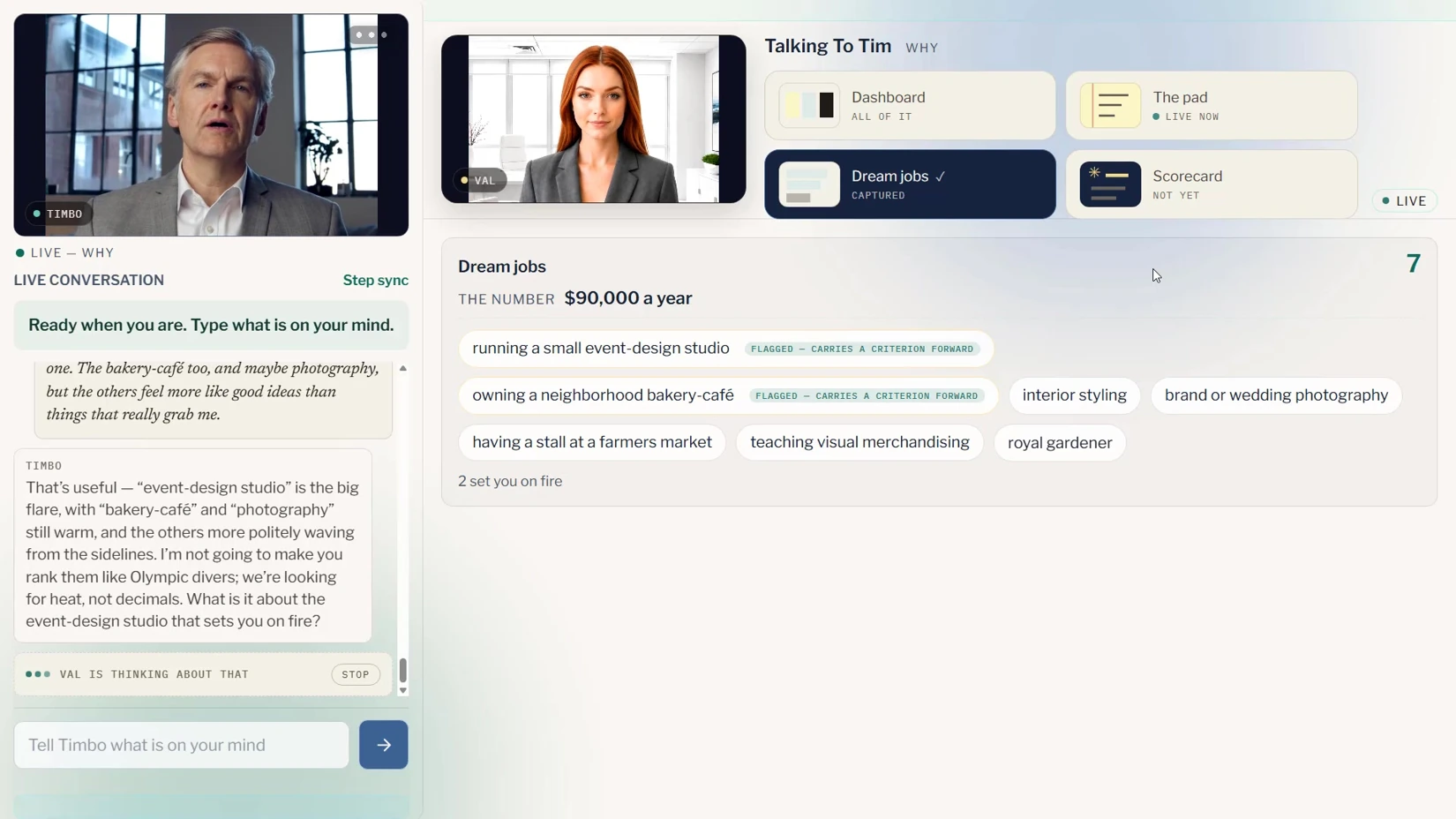
The yellow Pad open beside Tim.
The yellow PadAs the client describes what matters at work, their own words appear in the notebook.
The Dream Jobs board collecting the client’s ideas.
Dream JobsTim takes money off the table. Each idea becomes a card the client can revisit.
Tim’s scorecard with criteria and weights for comparing jobs.
The scorecardThe client changes how much a priority counts. The ranking updates, and Tim can discuss the revised choice.
Try weighting two job offers

In this illustration, Offer A pays more. Offer B has more flexible hours. Which matters more to you?

Offer A ranks first because you gave pay more weight.

See Tim’s full coaching session →

Some work takes a cast.

Tim and Val in the same rehearsal, with the Dream Jobs board open.

A partner for rehearsal

Val plays the client while Tim coaches. In a rehearsal, an expert can follow one answer all the way through: what Val said, what Tim asked next, and what landed on the Pad.

Meet Tim and Val →
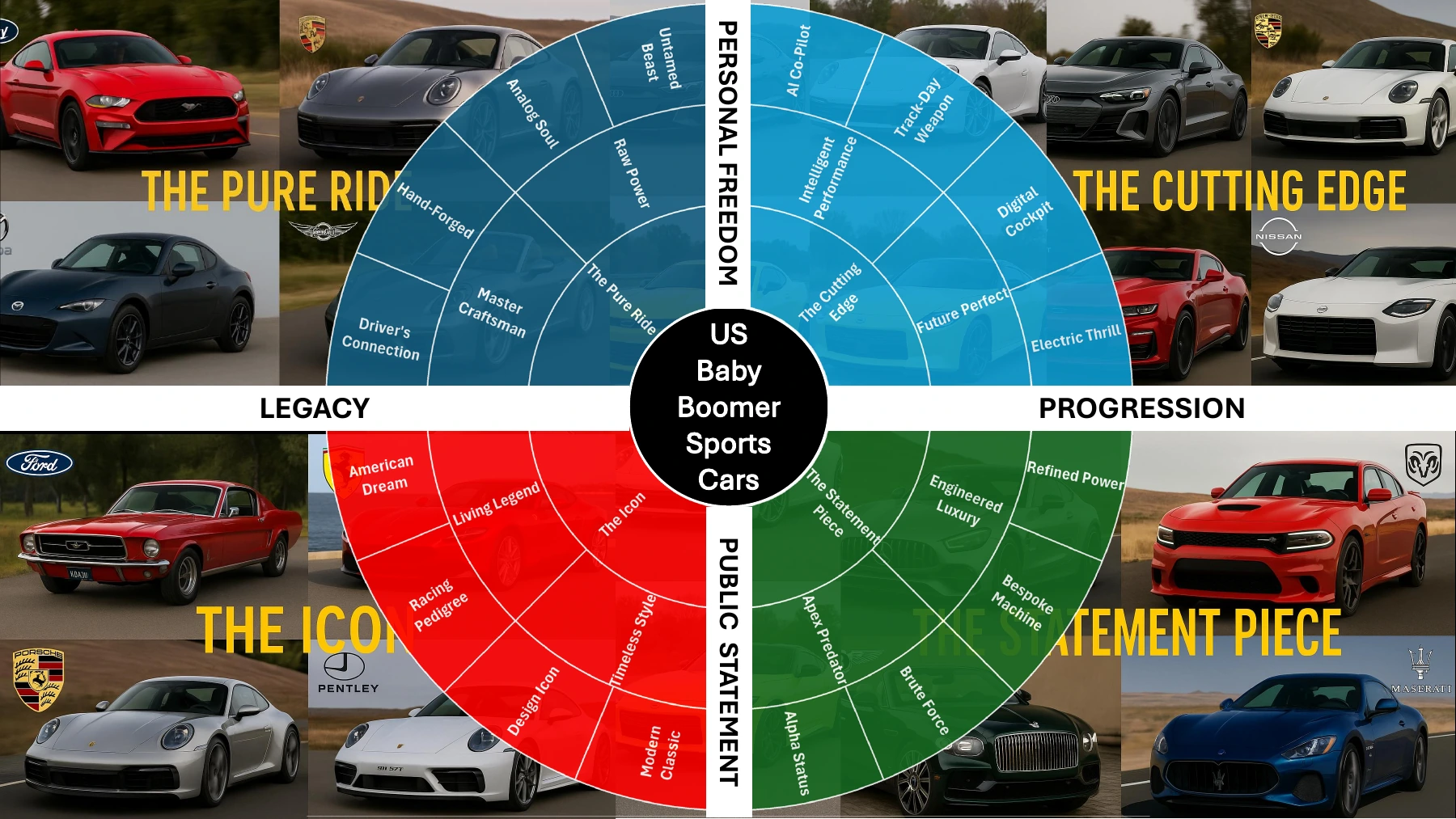
Semi’s map of cultural meanings in sports-car imagery.

A team for analysis

For a sports-car brief, Semi develops the cultural codes, a reporting agent organizes them, and a reviewer checks the evidence. The strategist can redirect the work between stages.

Follow Semi’s sports-car study →

What makes it your expert?

Will it use my sources?
You choose the material the guide can draw from. For a document-based Enactment, marked quotations can be checked against the passage they cite. When the source leaves a question open, the guide can say so.
Will it follow my rules?
You decide which words must be exact, which steps are required, and where the guide has room to respond. In Taylor’s check-in, a student can ask what a question means. Taylor explains it, then comes back to the same approved question. The assessment rules choose the next one.
Can it sound and look like us?
Bring your expert’s instructions, approved sources, and the pictures or tools they use to explain an idea. The guide’s face, voice, and visual style can reflect your organization. XI connects those choices to the models and tools the task calls for.
Inside the Enactor
Conversation and timing
Replies can reach the digital human a sentence at a time. A stage cue is tied to the sentence that calls for it, so a map arrives while the guide is talking about the place.
Sources and controls
Document lookup can bring a relevant passage into the answer. Software checks proposed actions against the Enactment’s allowed actions and available material before they reach the stage.
Rehearsal and review
A team can review what a session asked, showed, or declined. Tim demonstrates simulated-client rehearsal and editable coaching tools. Maya demonstrates guided care-plan review. A pilot selects and tests the capabilities its own task needs.

Why XI built a stage

Our founder’s conviction is that intelligence is meant to be shared and expressed through people and the world around them. That belief shapes what we build. A person should be able to join the conversation, point to something, question it, and change what happens next.

Each production is an Enactment. The guide has a role, the objects on stage carry meaning, and the Enactor keeps them in step. For a publisher or an expert, XI brings that approach to a particular body of work. See how it works in Talking To Tim.

A scene from the Enactor film: the guest stands beside Dana’s wine-advisor interface, with a Burgundy map and the wine label on the stage.
  1. Digital Human Narrator Dana speaks with the guest and explains what appears on screen.
  2. Web Chat The guest can type a question or read the conversation.
  3. Images The Burgundy map and wine label appear as Dana describes them.
  4. Menu The cards on the right let the guest choose what to explore next.

Hybrid AI keeps the expert in the conversation.

People rarely answer in the precise terms an expert system expects. A rules engine determines the next step. XI connects it to conversational AI so a person can reach that step in their own words.

Taylor from the campus check-in experience.
Taylor

ConverSage · A psychologist’s next question

For Taylor, XI built the inference engine around the psychologists’ assessment. Each approved question has an ID. When someone asks what a question means, Taylor can explain it and return to that same question. Once the person answers, the engine applies the script’s rules to select what comes next.

See Taylor’s campus check-in

Maya from the Maya RED experience.
Maya

MayaMD’s physician-designed symptom checker

Medical doctors designed MayaMD’s comprehensive symptom check. A person describes what they are experiencing in their own words. XI’s conversational layer turns that description into structured input for MayaMD’s rules-based clinical engine, which uses the doctors’ protocols to determine what to ask next.

The Extend Intelligence method

How a chapter becomes a coaching session.

Imagine a career author bringing one chapter to a pilot. Here is how we would work with the author to help a reader choose between two job offers.

What a first pilot includes
Discover

Where does someone get stuck, and what will they be able to do after your expert helps?

Bring the chapter and two sample job offers. Ask a reader to talk through how they would choose. Listen for the point where the advice on the page stops helping. Ask the author to define success. In this pilot, the reader should be able to explain a choice using their own priorities.
Model

What does your expert listen for, and which answer makes them change course?

Have the author coach someone through that decision. If the reader says they want flexibility, does the author open a worksheet or first ask what a flexible week would look like? Capture that follow-up and the reason the author chose it.
Enact

What should the person see, say, handle, or try at that moment?

Put the reader’s description of a good week on a shared pad. Let them edit it, decide how heavily it should count, and see what happens when they compare the two offers. The author can now try the scene and hear whether the questions sound like their own.
Govern

Which source should the guide rely on, and when should it hand the question back to a person?

Review the guide against the approved chapter. If an offer says nothing about working hours, leave that entry open. Help the reader frame a question for the employer. Have the author test that moment before participants try it.
Evolve

On a fresh example, can the person use what they learned, and where do they still need help?

Give the reader a fresh pair of offers. Ask which they would choose and why. If the choice surprises them, can they trace it to a weight they assigned? Use the point where they need help to decide what to revise.

What would your expert show someone?

Think about the last time someone brought your best expert a question. What did your expert reach for?

What do people still ask your best expert to walk them through?

Bring one conversation your expert has again and again. Together we can identify the question, the source, and the moment a demonstration would help.

Pilot inquiries info@ExtendIntelligence.com

What a pilot includes