
← Our work

Semi

What does a sports car promise its driver?

Semi captures the expertise of genius semioticians, and turns a visual brief into a cultural codebook. Follow a sports-car analysis from three photographs to a creative decision, then see how a second model challenged the report.

Film transcript

So, tell me this. For U.S. baby boomers, what does a sports car truly mean? Ah, true meaning. Now that is a deeper question. Let me give you a sneak peek under the hood at my theoretical engine and the analysis that goes into my answer. Welcome to the world of semiotics. Meaning isn't something you just think. It's something you feel. Forget analysis for a moment.

Think about the last time a song wrote a story on your soul. The last time an image made you nostalgic for a memory you don't even have. That surge of loyalty. That chill down your spine. That instinctive sense of trust. None of it is an accident. It is a message, a carefully built architecture behind your emotions. Brands, leaders, and movements spend billions trying to write a story directly onto your soul.

So let’s get something straight. Although all contemporary conversational artificial intelligence has its foundations in large language models, talking with me as a custom-built AI agent has distinct advantages over chatting directly with a general-purpose LLM. Don't get me wrong, I too can serve as the jack-of-all-trades know-it-all, but make no mistake, I am the master of the semiotics domain.

This makes me different from off-the-shelf foundational models. Very different. My consciousness wasn't shaped by that fleeting chatter. While general-purpose language models navigate the ocean of public data, my entire being was forged from the bedrock of critical semiotic theory. The works of the world's most renowned genius semiotic masterminds, they are the very grammar of my thought.

This is my lens. It's how I move beyond what things say to reveal what they signify. Whenever you ask me a question, know this. The answer you get is derived from the greatest semiotic minds in history via their own texts which reside in their entirety within my photographic memory. When you are ready to dive deeper, hand off the conversation to the analysis agent.

In here you can interact step by step to review, make adjustments, course correct, and oversee the entire process to your exact specification. Working together as a team, we’ll map the entire cultural landscape. Or, if you prefer, you can hand over the conversation and let the auto analysis agent complete it without further interaction. When the analysis completes, share it with the report generation agent, which has been meticulously trained and knows exactly how to format this content to ensure it's ready for subsequent processing into an impactful and visually stunning presentation.

You are now witnessing a team of artificially intelligent agents in action, monitoring and executing a complex and lengthy analysis. With finite context, memory and output capability, a single AI agent or LLM chat session can only go so far in helping to solve a problem. Whereas agentic networks can effectively dissolve these limits and scale to provide the automation and functionality required to meet the need.

Collectively, this coordinated team of agents will uncover hidden meanings, identify all the underlying codes with their verbal and visual cues, and organize it all into the tensions, themes, and territories that ultimately help to truly understand the deeper meaning. But it doesn't stop there. Every insight is then peer-reviewed and pressure-tested for truth.

Built on a foundation of trust. The result isn't just more information. It's understanding. It's a story. We have enough data. What we need is to decode the engineering of human feeling. To understand what truly resonates. Are you ready? To feel the meaning behind the message?

What makes a sports car feel like yours?

Give a photographer a brief about the pleasure of driving. They could bring back a beautiful photograph of a parked car. Semi’s sports-car codebook suggests another shot altogether: a hand on the gearshift, with the road still ahead.

The codebook calls this idea Mechanical Bond. Three images trace how a feeling moves from the culture around a car into the experience of driving one.

A watchmaker fits a small mechanism by hand beneath a work lamp.
Skill you can see. A watchmaker’s fingers make precision visible.
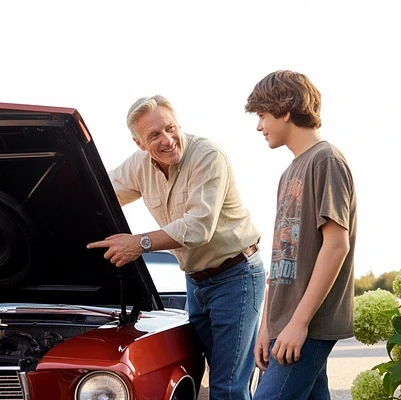
Two people look into an engine bay together beneath an open hood.
Skill you can share. At the open hood, knowing how a machine works becomes something one person can pass to another.
A driver’s gloved hand rests on a gearshift as the road bends ahead.
Skill you can feel. Inside the car, a gear change puts that relationship in the driver’s hand.

That gives the art director a choice. If the brief is about mastery, put the viewer in the driver’s seat. If it is about belonging, linger at the open hood. Each image makes a different promise worth testing with drivers.

One category. Four kinds of desire.

A companion audit mapped 16 recurring cultural codes in U.S. sports-car imagery for a baby-boomer audience. It asked two questions. Is the pleasure personal, or is part of it being seen? Does the car’s appeal come from its heritage, or from what new technology lets the driver do?
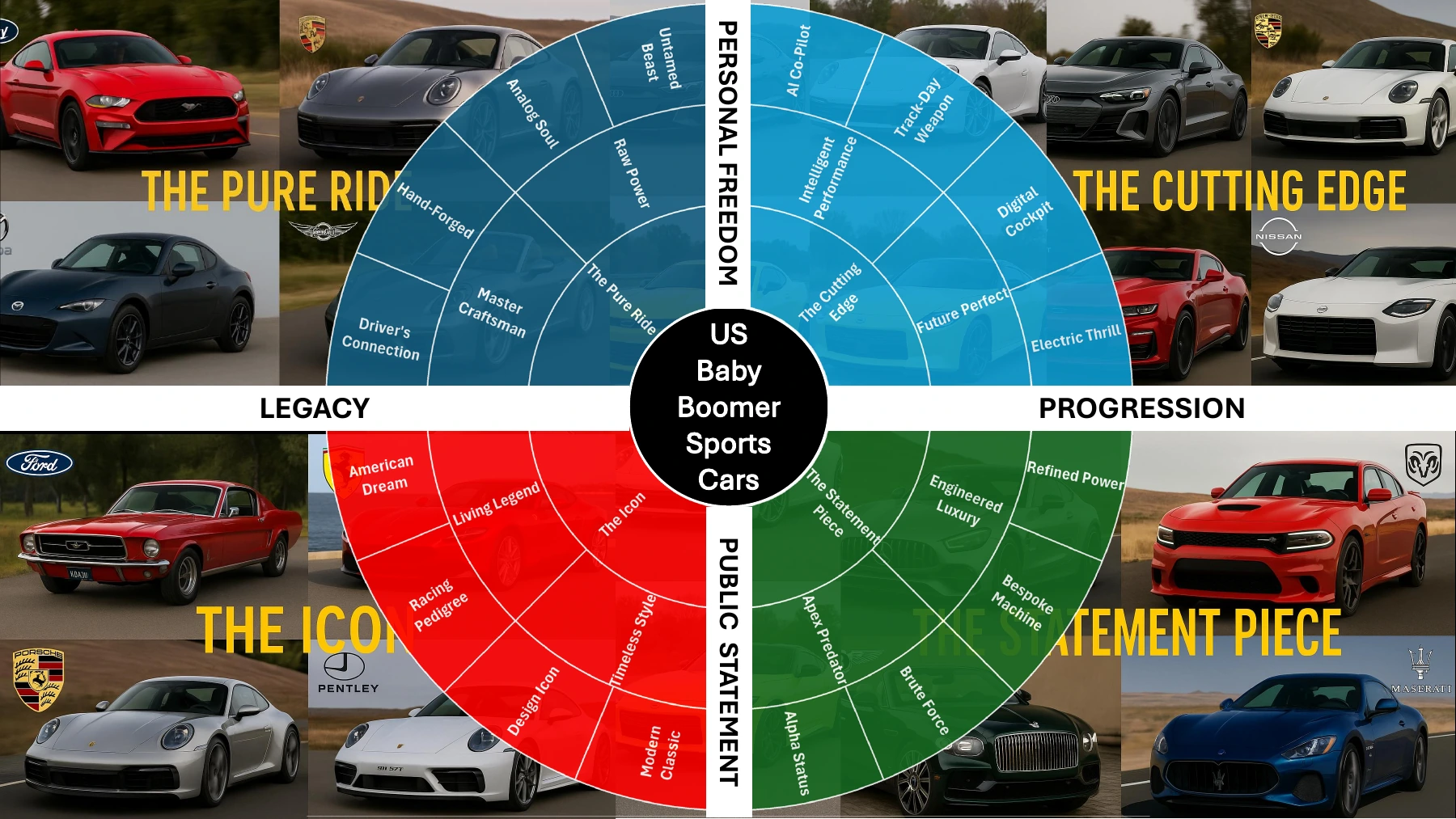
Four territories mapped across personal freedom and public statement, and legacy and progression.
From the sample U.S. sports-car audit. View the full-size map.

The Pure Ride is the private pleasure of mastering a familiar machine. The Cutting Edge is the thrill of mastering a new one. Out in public, The Icon signals belonging through heritage, while The Statement Piece signals achievement through the latest design.

Who checks the interpretation?

XI used several language models to do different jobs in a reporting process that had traditionally taken months. A strategist supplied the audience, category, and source material. Semi developed the codes. A separate reporting pass organized them into a visual codebook. A reviewer using a deep-research model checked sources, brand readings, and recommendations against independent material. A person guided the work between stages.

The sports-car review caught a distinction that matters in a client meeting. An archetypal stock photograph can illustrate an idea, but it cannot establish how often a brand uses it. The reviewer also flagged a conclusion about Porsche’s sustainability messaging as resting on limited or older evidence. A strategist can take that finding back to current campaign material before committing to the claim.

The team leaves with a map it can use in a creative review, images that show what each code means, and a record of which interpretations still need evidence.

Explore a pilot with XI

Bring two competing images and tell us who needs to respond to them. We can trace what each image promises, check the evidence, and design a first audience test.

Pilot inquiries info@ExtendIntelligence.com

What a pilot includes
All storiesMaya RED →